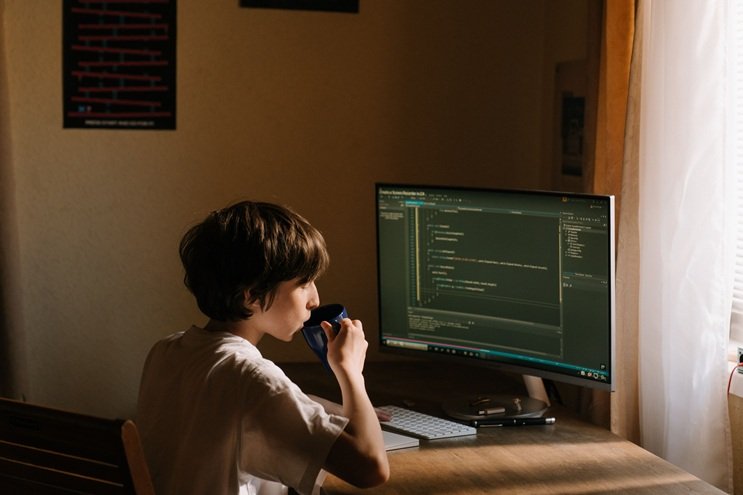
When people hear “web development,” they sometimes imagine complicated code, large software companies, and experienced programmers sitting behind multiple monitors.
That’s only part of the story.
A teenager who is just beginning can start much smaller—and still create something real.
A simple webpage can become a personal portfolio. A small JavaScript project can become an interactive game. A few pages can become a complete website for a club, school project, small business, or personal idea.
That’s what makes web development such an interesting place to start.
Start with a webpage
The first step doesn’t need to be complicated.
HTML provides the structure of a webpage. CSS controls how that page looks and is arranged, while JavaScript can add interaction and behaviour.
Current Code.org materials for teenagers teach web development through exactly this kind of progression, moving from HTML and CSS into interactive projects and problem-solving.
You don’t need to understand everything on day one.
You just need somewhere to start.
Build a personal website
Imagine creating a website that introduces you.
It could include:
- Your interests
- Your favourite projects
- Your artwork
- Your photography
- Your writing
- Your coding projects
- A short introduction about yourself
Suddenly, you’re not just learning code.
You’re creating something that represents you.
Build a game
Once you begin learning JavaScript, you can experiment with interaction.
A simple browser game could involve:
- Clicking targets
- Answering questions
- Collecting points
- Making choices
- Solving puzzles
- Timing challenges
The game doesn’t need to compete with commercial games.
The point is to understand how an idea becomes something interactive.
Build a website that solves a problem
This is where coding becomes even more interesting.
Instead of asking:
“What website should I build?”
Ask:
“What problem could a website help solve?”
Maybe students at your school need a better way to find useful resources.
Maybe a local sports club needs a website.
Maybe a small business needs an online presence.
Maybe you want to create a study planner.
Once you start thinking about problems, coding becomes more than typing commands into a computer.
You’re designing solutions.
Build with other people
Web development also teaches something that isn’t written in HTML or JavaScript: collaboration.
A website project can involve someone researching content, another person designing the interface, and another person writing code.
You also learn to test your work, find mistakes, receive feedback, and improve what you’ve created.
These are valuable habits beyond programming.
You don’t have to become a professional developer
Learning web development doesn’t mean you have to decide today that you’re going to become a software engineer.
You might eventually discover that you enjoy design more.
Or artificial intelligence.
Or entrepreneurship.
Or product development.
Or something completely different.
The point of learning technology as a teenager is to explore what is possible.
And web development gives you a particularly satisfying way to do that because your ideas can become something you can actually see, click, test, and share.
Start small. Make something. Then make it better.
You don’t need to build the next big social network.
Your first website can be simple.
What matters is that you built it.